
▸ West End, Brisbane
Come and build rocket fast drones
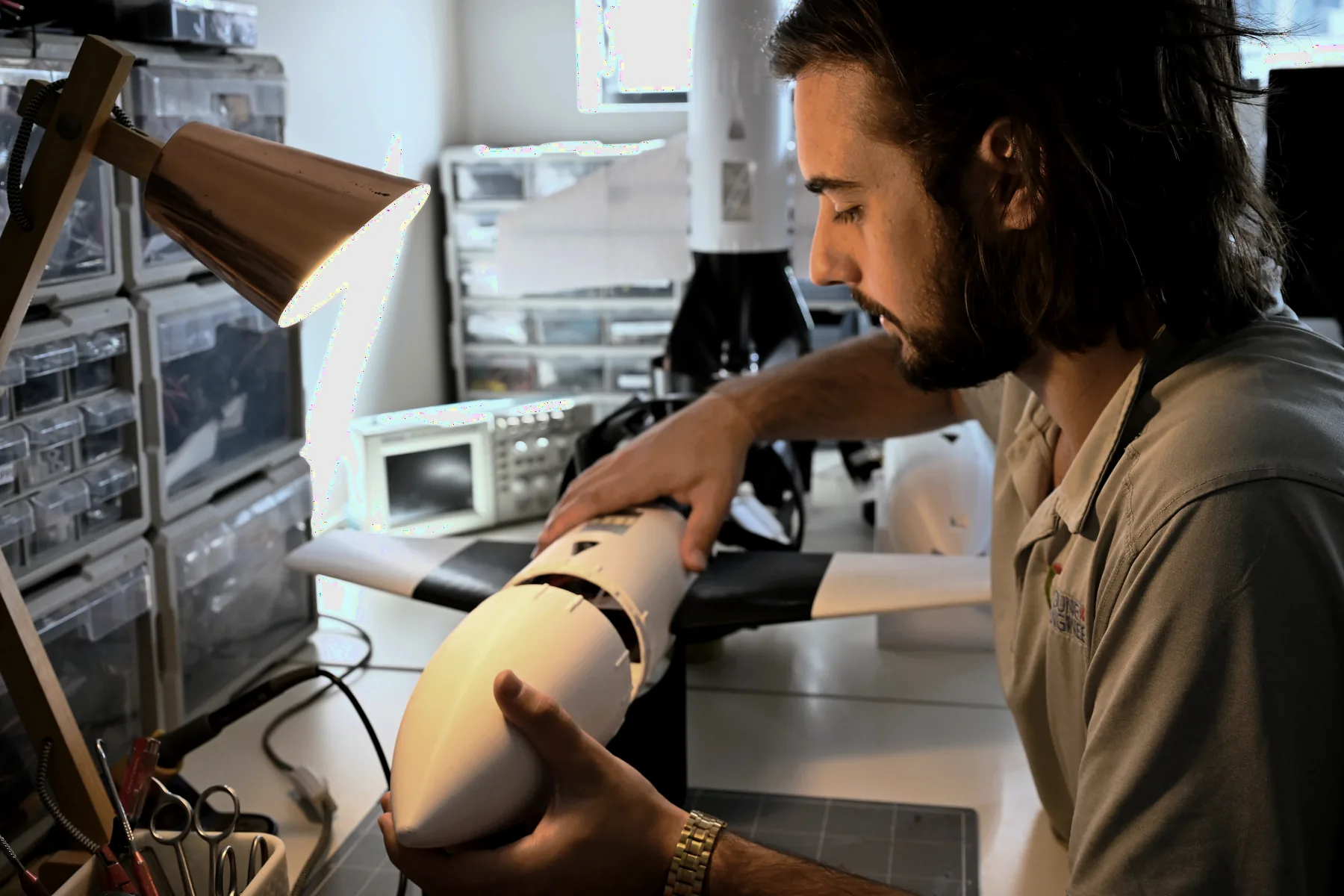
We design, print, wire and fly high-speed autonomous aircraft. Not models of them. Not simulations of them. The actual aircraft, in a workshop you can walk into, flown in paddocks outside Brisbane most weeks.
We are looking for students to work on them. Mostly engineers, and also the two people who will go and find our customers and tell the world we exist.
▸ 01 / What we build
A tube goes up. A wing comes out. It goes fast.
Our aircraft take off vertically from a standing start, tip over into forward flight, fly a mission at speed, then come back and land softly on the spot they were asked to. No runway, no launcher, no assembly, no recovery crew walking into a paddock to collect it.
The lead mission is medical logistics: getting blood, plasma and pharmaceuticals to someone who needs them inside the window where it still changes the outcome. Road transport takes as long as the road takes. We are trying to make that a flight instead, and the reason the aircraft is fast is that in that mission speed is the whole point.
Around that sit the other things a small, deep engineering company has to be good at: autonomy and guidance, simulation at scale, airspace and regulation, manufacturing that holds tolerance, and enough AI in the loop that a team this size can behave like a much larger one.
- Demonstrated top speed
- 176km/h in flight. Among the fastest reusable electric VTOL aircraft in the 1 to 10 kg class.
- Demonstrated cruise
- 143km/h, sustained, carrying a payload.
- Longest flight
- 12.2km, landed with 40% of the battery still in it.
- Hard landings survived
- LotsWe break things so our customers do not have to. The crash reel is a point of pride, not something we hide.
▸ 02 / What it is actually like
You will touch the aircraft
This is a small company. There is no graduate programme, no rotation, no team of twelve where your work disappears into somebody's backlog. You get a bounded piece of a real programme, a named person who owns it with you, and a review that is honest.
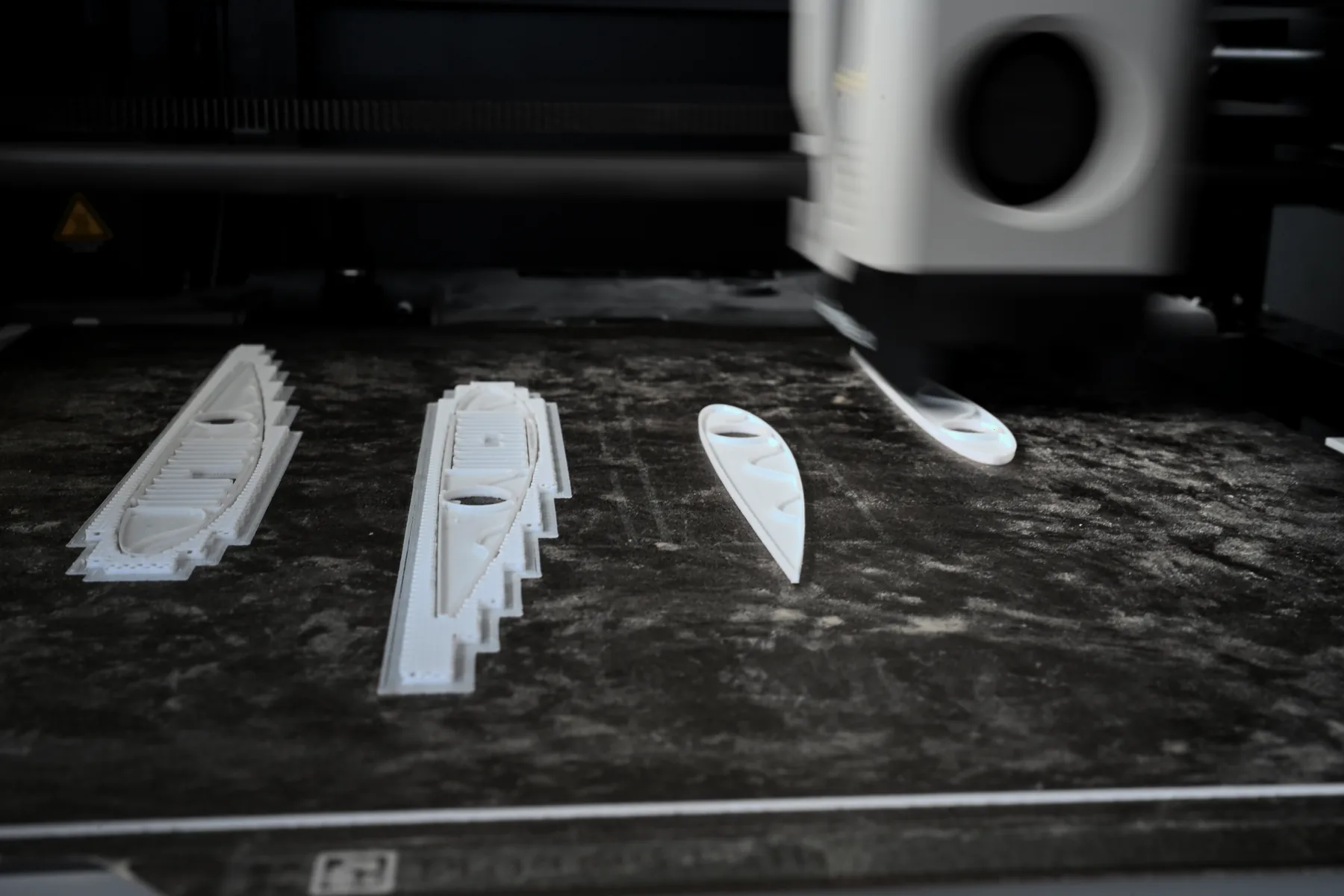
You will pull parts off a print bed, wire them up, put them on a bench, break them, and work out why. You will be on flight-test days as crew. You will also write things down properly, because a result nobody can reproduce is not a result here, and that discipline is most of what separates an engineer from an enthusiast.
We expect you to use AI, heavily and openly. Everyone here does. What we care about is whether you can tell when it is wrong.
You need to be on site. Our workshop is in West End, on the river, a few minutes from the city. If you want to build aircraft you have to be able to touch them, and talk to the people touching them. Fully remote does not work for this and we will not pretend it does. We will send you the address when we arrange a time to meet.
▸ 03 / Which one are you
Pick your kind of work
Every discipline below has real projects behind it, written up properly: what the work is, what you would learn, what you would hand back, and what we are not promising. Choose the one that fits and you will see the projects filtered to it. You can look at all of them either way.
Engineering
Electrical / electronics
6 projects
Aircraft power, switching, sensing and protection. Schematic to layout to a board you bring up on the bench yourself.
Electrical, Electrical & Computer, Mechatronic
Embedded / firmware
5 projects
The computers that fly the aircraft. STM32-class avionics, motor-control firmware, PX4 board support and hardware-in-the-loop.
Computer, Electrical, Mechatronic, Software
Software / computer science
10 projects
Run thousands of flights before breakfast. Simulation orchestration, flight-log analytics, tooling that turns a change into evidence.
Software, Computer Science, Computer, Mechatronic
AI / perception / navigation
5 projects
Navigate when GNSS is gone. Visual-inertial odometry, estimator integrity, and the AI infrastructure the engineering team runs on.
Software, Computer Science, Mechatronic, Aerospace
Aerospace / performance
6 projects
Decide what the next aircraft can actually do. Sizing, aerodynamics, propeller and motor matching, then correlate it against real flight data.
Aerospace, Mechanical, Mechatronic
Mechanical / CAD / structures
7 projects
Turn intent into an airframe with known mass, balance and stiffness, then build it and weigh it to find out how wrong the model was.
Mechanical, Mechatronic, Aerospace, Materials
Manufacturing / production
5 projects
Make one aircraft, then make the tenth one identical. Print farm, fixtures, travellers, inspection and the processes that hold tolerance.
Mechanical, Mechatronic, Manufacturing, Materials
Test / flight operations
16 projects
Instrument it, run it to the edge, and come back with data nobody can argue with. Bench, dynamometer and flight-test campaigns.
Aerospace, Mechanical, Mechatronic, Electrical
Business and marketing
Two roles that are not engineering and are not filler. A company this size does not have a commercial function or a marketing function, which means there is nobody above you doing the interesting part. Read on for what is actually in it for you, because it is different from what is in it for the engineers.
Business / commerce / sales
1 project
Find out who actually buys this, go and talk to them, and bring back the answer that decides which aircraft we build next.
Commerce, Business, Economics, Marketing, Engineering + Commerce
Marketing / media / visual arts
1 project
Own the public face of a company that flies things worth filming. Including, if you want it, flying the camera yourself.
Marketing, Communications, Film and Screen, Visual Arts, Design, Journalism
▸ 04 / If you are not an engineer
What is actually in it for you
The engineers reading this page mostly need no persuading, because the aircraft do the persuading. If you are a commerce or a visual-arts student, that is not much of an offer. So here is the specific one.
Business and sales
You would be the commercial function. Not an assistant to it. There is no pipeline to inherit and no team to sit under, so the market map, the outreach, the discovery and the recommendation are all yours, reporting to the founder.
Your findings change what gets built. We genuinely do not know whether the demand is for small aircraft or large ones, whether people want to buy them or hire us to fly them. There is a fleet roadmap and a database of around 390 competing aircraft. If what you hear on the phone contradicts the roadmap, that is a finding, and it can change the plan.
You leave with a track record and a number attached to it.A verifiable sales result at a real company is the most portable thing in business, and it is very hard to get as a student anywhere else.
There is also a full-time business development role in the company plan, funded from a grant that has not landed. We will not promise it to you. We will say that we would rather hire someone who has already done the work.
Marketing, media and film
You could fly the camera. We hold our own CASA remote operator certificate, and for someone who would genuinely use it we would pursue the approval to run FPV on our ranges. Flying FPV legally in Australia is close to unobtainable as an individual. There are real conditions, they are spelled out in the brief, and we are not going to pretend the approval is guaranteed.
The footage is extraordinary and almost none of it is public.Vertical launches, transitions, high-speed passes, and a print farm that looks like a set. Where a shot cannot be flown, the flight simulator runs real autopilot code and can generate it.
The voice is fun and it is yours to extend. The brand is cheeky, technical and honest about breaking things. Nobody here is going to ask you to write about leveraging synergies.
Your work is public and attributable, which a unit assignment never is.
One honest note for both. These run as university placements or capstone projects for credit, and both briefs say so plainly. If you are looking for paid work, tell us when you apply rather than not applying, and we will give you a straight answer about where that stands.
▸ 05 / How this works
Four steps, no recruiters
1. Unlock the catalogue
Tell us who you are and you are through immediately. No waiting on a human, no approval queue. If somebody gave you a passcode, that works too.
2. Read the projects properly
They are long on purpose. We would much rather you self-select out of something than arrive in week three and discover it involves batteries that can catch fire.
3. Send us a plan
Pick one project and write a plan for the time you actually have. Tell us the exact days and hours you can be on site. Use AI to write it and tell us how you used it. We read every one.
Right now only the commercial placements are taking plans. The engineering projects are full for this intake, but unlocking the catalogue puts you on the list we write to first when that changes.
4. Talk to Joni
If the plan shows you understood the problem, you will hear back from the founder directly, because there is nobody in between.
One thing to check before you start
A placement here is open to Australian citizens and permanent residents. We work in Australian defence industry under the Defence Trade Controls Act 2012 and the Defence Industry Security Program, and those rules decide who is allowed to work on this material. It applies to every project on this site, the business and marketing ones included.
We put it here, on the way in, rather than at the end of an application. It is a legal condition on us and not a view about people, and it is the only status question we ask. If you are offered a placement we will ask for proof of it, and for a national police check, which we pay for.